Rackfox helps you find safe bike parking in London and 12 other English cities. In London alone we map more than 27,000 bike racks, stands and lockers, and we rate each one by how many bicycle thefts the police recorded within 150 m in the last 12 months.
How it works
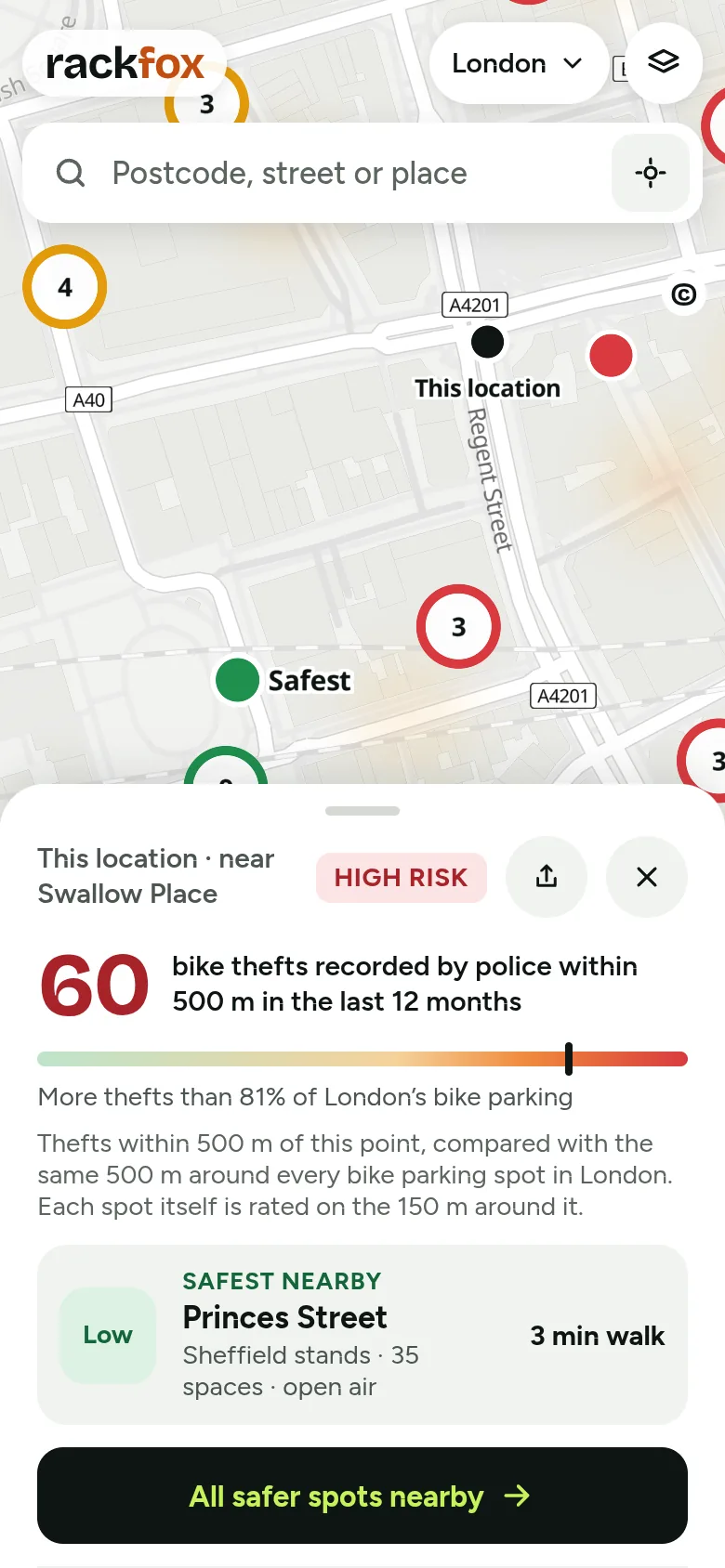
1. Check where you are going to lock up. Search a postcode, street or station, or use your location. Rackfox counts the bike thefts the police recorded around that point in the last year and compares it with every bike parking spot in the city. Here, next to Oxford Circus:
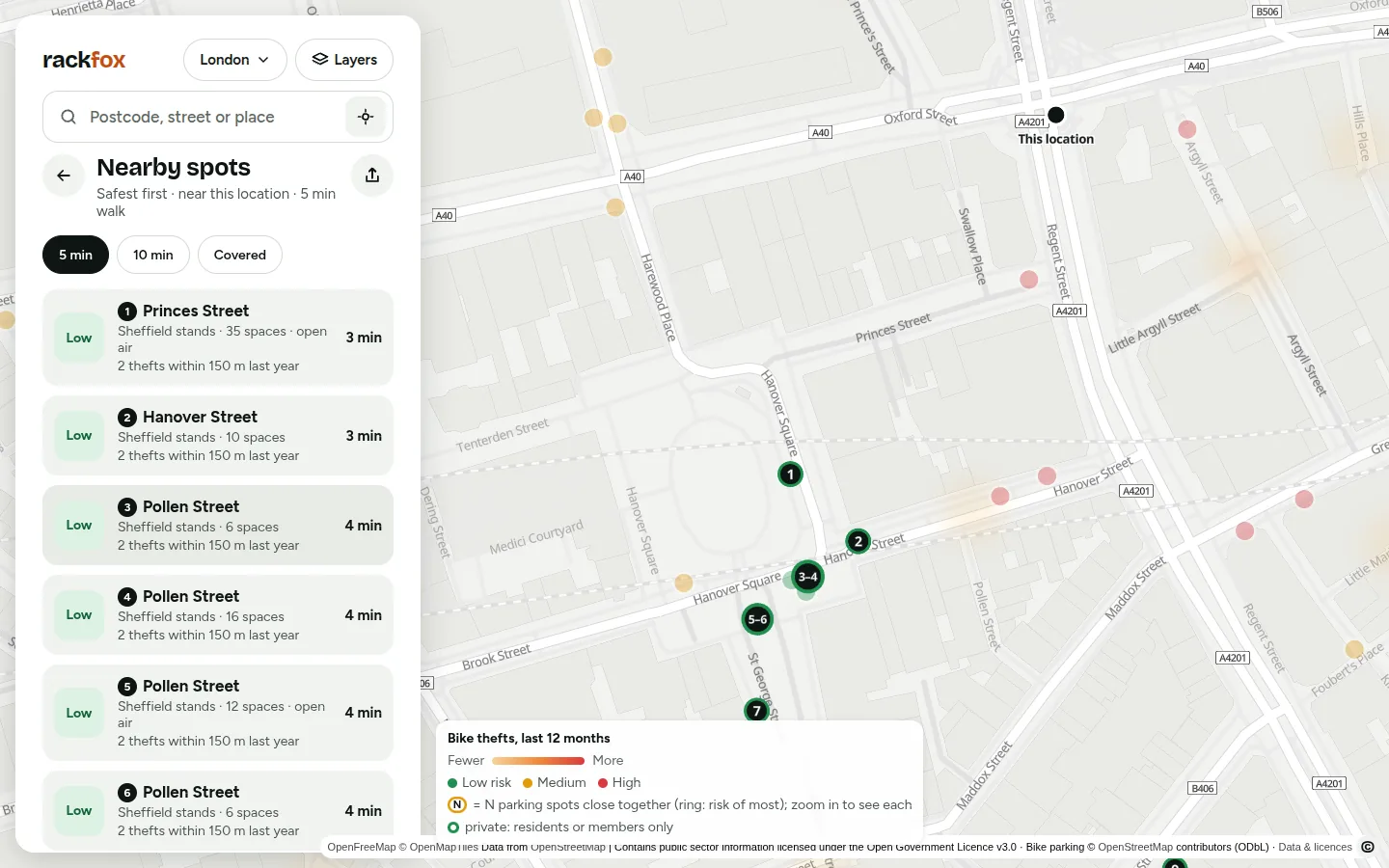
2. Find a safer rack nearby. “Safer spots nearby” lists the bike parking with the lowest theft risk within a 5- or 10-minute walk, lowest risk first, with the walking time. One tap opens the route in Google Maps, Apple Maps or Citymapper.
3. Lock it well. Even at a low-risk rack, lock the frame, not just a wheel, ideally with a Sold Secure Gold lock.
Where the data comes from
- Bike thefts: street-level crime data published monthly by the police at data.police.uk, under the Open Government Licence v3.0.
- Bike parking, shops and repairs: OpenStreetMap, the open map built by volunteers (ODbL).
- Borough and ward boundaries: Office for National Statistics (OGL).
- Station cycle parking: National Rail, Network Rail and the train operators.
- Cities outside the UK: each city’s police open data, listed on Data & licences.
Police place each crime at an anonymised point near where it happened, so locations are approximate, and many thefts are never reported. A low risk rating is not a guarantee. How the rating works: what we add to the data.
Who runs it

I’m Yevhenii Vaskevych, and I built Rackfox. I’m from Ukraine, and a while ago my bike was stolen. Afterwards I wanted to know something simple: is the place where I leave my bike more likely to see thefts than the one round the corner? In Ukraine there is no public data that could answer that.
Looking for an answer, I found that the UK, and a few other countries, do publish it: the police release where crimes happen, month by month, bike thefts included. Put that next to a map of every bike rack, and you can see which spots have fewer thefts around them. That is what Rackfox does, so you can pick a lower-risk place before you lock up.
Rackfox is independent: it is not affiliated with the police, Transport for London, any council, insurer or retailer.
How we make money
Rackfox is free to use. Some pages may show partner offers labelled “Ad” for bike insurance and locks; we earn a commission if you buy through them. It never changes the ratings or which parking we show. How that works.
Corrections and complaints
We publish statistics from official data and try hard to get them right, but data changes and mistakes happen. If a figure, a place or a rating on Rackfox looks wrong, or you run a business near a place we show and think the presentation is unfair, email [email protected] with the page link. We acknowledge within 5 working days, check the source data, and correct or annotate the page if we got it wrong. We don’t remove accurate police statistics, but we will add context.
Contact
Spotted a missing or wrong bike rack, have a question about the data, or want to work with us? Email [email protected]. We read everything; press requests welcome.